
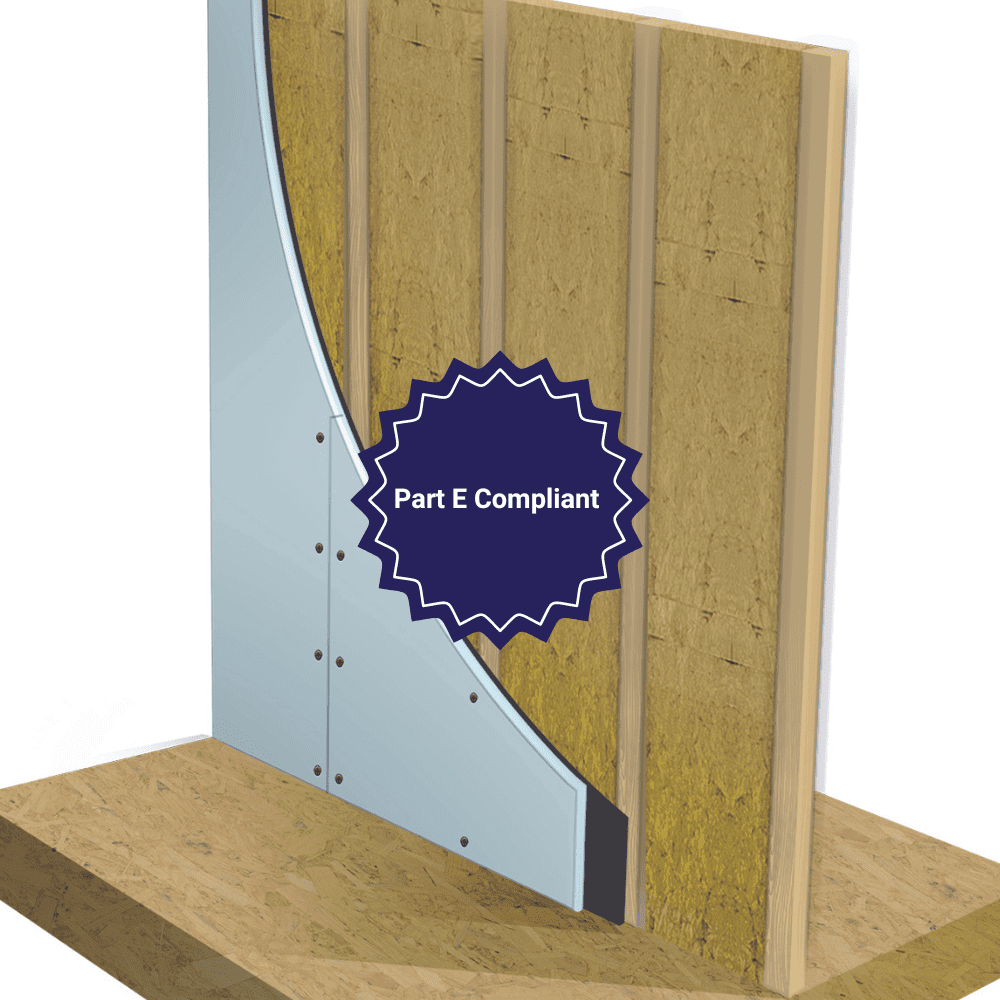
Part E Stud Wall Solution
Price range: £214.89 through £772.55 ex. VAT
Estimated Delivery: 3 - 5 Days
(9th Jan - 11th Jan)
Ensure stud walls meet Part E Building Regulations with this soundproofing kit. The Part E Stud Wall Kit Solution is designed to comply with current Part E regulations for reducing the passage of sound.
Buy a soundproofing system and save on buying the products individually.
Comply with Part E Building Regulations using this soundproofing kit for stud walls
Part E stud wall soundproofing system
Pass the sound test requirements in the Part E document using this stud wall partition system. The system combines all the required elements to exceed the required levels and ensures that expensive retests and remedial work are not needed to correct a failed sound test.
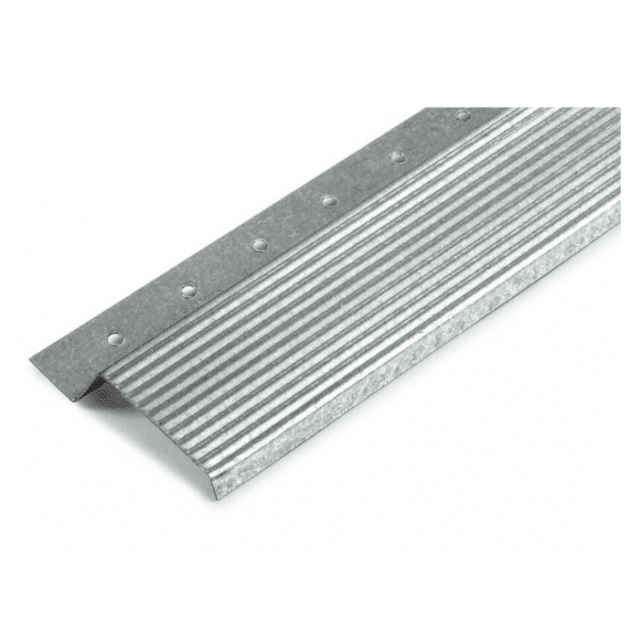
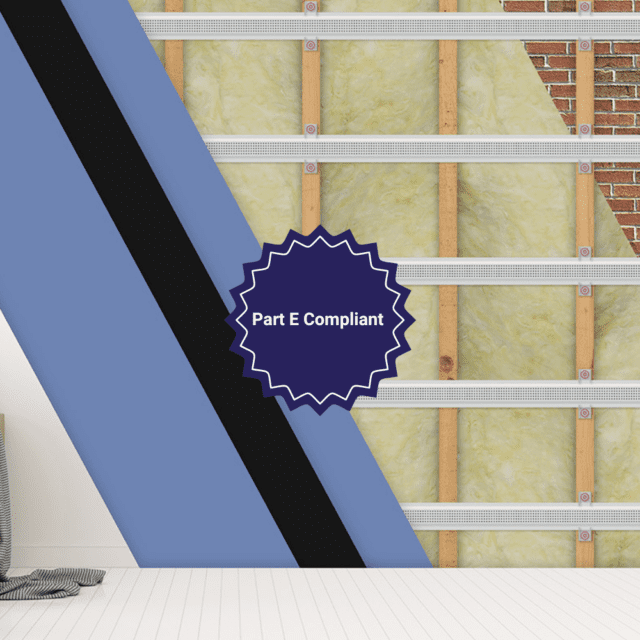
It consists of the Soundbreaker Bar resilient channel isolation system, which decouples the stud frame from the stud frame. The isolation created using the system reduces the sound typically transferred between partition walls.
The other elements within the soundproof system add mass and density and improve the wall’s ability to block sound transference between rooms. The DFM acoustic insulation, soundproof plasterboards, and mass-loaded vinyl ensure the area meets and exceeds the Part E Building Regulation standards.
Perfomance
55dB when applied to one side of a stud frame with 12mm plasterboard on the other side
Thickness
A slim solution only 47mm from the surface of the stud frame
Soundbreaker Bars
Ensure your separating stud walls meet Part E using this slim soundproofing system
Materials supplied with this system:
- Acoustic insulation 50mm/60kg/m3 – High-density sound insulation slabs
- Soundbraker bars 3m – Decoupling channel to isolate the stud frame from the boarding
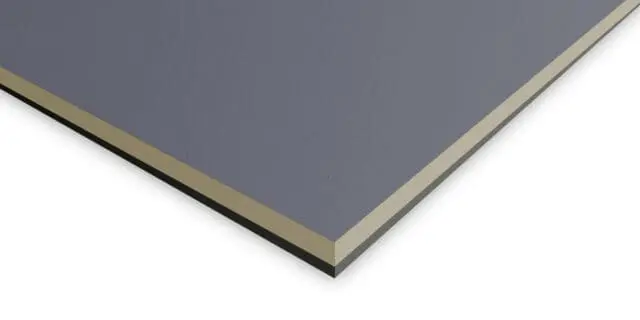
- Noisestop 1 Plus Panel 18mm 1200mm x 1200mm (1.44sqm) – 12.5mm soundboard laminated with 10kg mass-loaded vinyl
- 12.5mm Acoustic plasterboard 1200mm x 1200mm (1.44sqm) – Denser than standard plasterboard
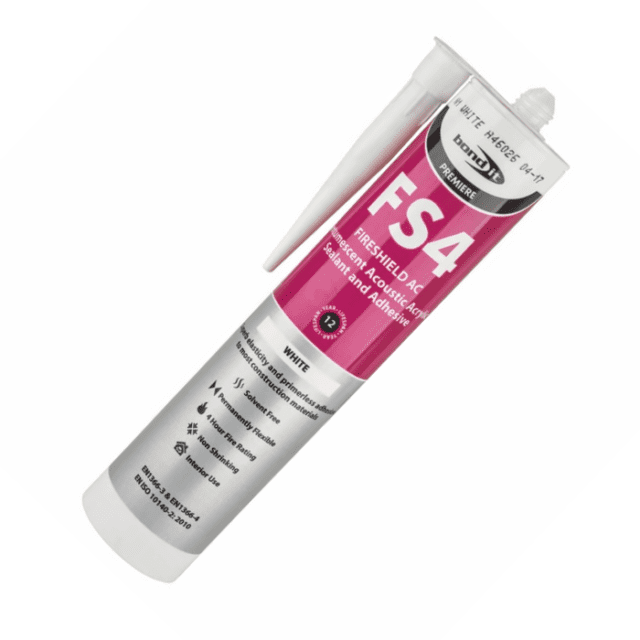
- Acoustic sealant 310ml
Select the required Total Wall Area from the dropdown box at the top of the page to see the quantities supplied with this system.
We recommend ordering areas individually and adding them to the basket rather than adding them to one large area. You can order multiple areas in the same order.

Quantity of materials supplied in your order
| Area m2 | DFM 50mm/60kg (6.48sqm per pack) | Soundbreaker Bars 3m | Noisestop 1 Plus Panel 18mm (1.44sqm) | 12.5mm Soundboard (1.44sqm) | Acoustic sealants (310ml standard size) |
|---|---|---|---|---|---|
| 5 | 1 | 5 | 4 | 4 | 2 |
| 6 | 1 | 6 | 5 | 5 | 2 |
| 7 | 2 | 7 | 5 | 5 | 2 |
| 8 | 2 | 8 | 6 | 6 | 2 |
| 9 | 2 | 9 | 7 | 7 | 2 |
| 10 | 2 | 10 | 7 | 7 | 2 |
| 11 | 2 | 11 | 8 | 8 | 2 |
| 12 | 2 | 12 | 9 | 9 | 2 |
| 13 | 3 | 13 | 10 | 10 | 3 |
| 14 | 3 | 14 | 10 | 10 | 3 |
| 15 | 3 | 15 | 11 | 11 | 3 |
| 16 | 3 | 16 | 12 | 12 | 4 |
| 17 | 3 | 17 | 12 | 12 | 4 |
| 18 | 3 | 18 | 13 | 13 | 4 |
| 19 | 3 | 19 | 14 | 14 | 4 |
| 20 | 4 | 20 | 14 | 14 | 4 |
- System thickness 47mm (from the stud frame)
- Noise reduction 55dB
- Fire one hour
Thermal Resistance R:
- Acoustic plasterboard 12.5 mm = 0.050 m2 K/W
- Acoustic plasterboard 15.0 mm = 0.060 m2 K/W
- Mass-loaded vinyl 0.14 m² K/W
- Acoustic insulation 2.90 W/mK
Thermal Conductivity λR:
- Acoustic plasterboard 0.25 W/mK to BS EN 12524:2000
- Mass-loaded vinyl 0.037 W/mK
- Acoustic insulation 0.034 W/mK
Reaction to Fire
- Acoustic plasterboard 12.5mm & 15mm Euroclass A2-s1, d0
- Mass-loaded vinyl 10kg EN 13501-1 B-s2,d0 (2)
- Acoustic insulation EN13501-1: A1
Airborne sound insulation values
- RW 55dB
Part E Building Regulations requires a minimum value of at least 43-45dB
Note: Every 10 decibels(dB) reduction in noise level is roughly perceived as a halving of the perceived loudness. So, for instance, if you have a sound that measures 70dB and it decreases to 60dB, it would sound about half as loud to the human ear. Decibels explained.
Apply the stud wall soundproofing system to new or existing stud walls.
If you are installing the system onto an existing wall, you must remove the plasterboard from one side of the wall. If you are building a new stud wall, apply isolation strips to the perimeter of the frame.
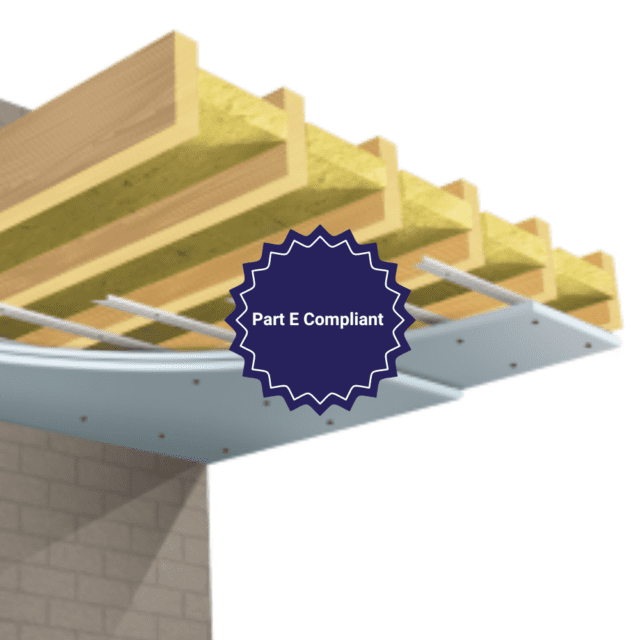
Reduce potential flanking paths by insulating the floor and ceiling cavity with acoustic insulation slabs.
- Remove the plasterboard from one side of the wall if you are soundproofing an existing wall.
- Use the Isolation Strips around the new stud frame to install a new stud wall.
- Infill the stud cavity with acoustic insulation, ensuring the whole area is filled. If you cut the slabs wider than the opening, they will friction fit between the studs.
- Fit the soundbreaker bars at 600mm centres and approximately 50mm from the floor and ceiling. The bars are attached to the frame by screwing through the pre-drilled holes.
- Attach the first layer of boarding to the bars using drywall screws through the boards into the wide corrugated flange on the soundbreaker bar.
- Attach the second layer of boarding using the same method, staggering the joints of the first layer where possible.
- When attaching the boards, leave a 3mm gap around the wall’s perimeter, and fill the gap with acoustic sealant upon completion.
- The wall can be finished as with standard plasterboard before decorating.
- Electrical outlets can be installed into the wall, and acoustic putty pads can be used to ensure the acoustic integrity of the wall.
Delivering soundproofing throughout the UK
Due to the nature of most of the materials we supply, orders are typically delivered on pallets.
All orders will be carefully wrapped, protected, and securely palletised to ensure they arrive in the best possible condition. Goods will be delivered as near to the property as possible. The drivers will not be able to carry orders into your property.
Deliveries are made between 8:00 a.m. and 6:00 p.m. Monday to Friday.
We charge a flat delivery rate of £60 plus VAT for most palletised deliveries. We do not charge per pallet, regardless of the number of pallets used to deliver your order.
Certain postcodes will incur a higher delivery charge than our standard rate, including those in Northern Ireland, Northern Scotland, and the Islands off the mainland.
Orders placed for items weighing less than 20kg will be sent via courier for £20 plus VAT.
We have a high stock level and typically deliver orders in approximately three to four working days.
If you would like to speak with us about your delivery, please call 01423 339163. Alternatively, you can send us your delivery enquiry.
Please review our full delivery terms for more information.
We don’t currently deliver outside the UK.
Part E requirements for a separating wall
It is important to note these are the minimum sound insulation standards your separating wall must achieve to meet Part E.
| Dwelling-houses and flats – performance standards for separating walls, separating floors, and stairs that have a separating function | Airborne sound insulation DnT,w + Ctr dB (Minimum values) | Impact sound insulation L'nT,w dB (Maximum values) |
|---|---|---|
| Purpose built dwellings house & flats | ||
| Walls | 45dB | - |
| Floors & stairs | 45dB | 62 |
| Dwelling-houses and flats formed by material change of use | ||
| Walls | 43dB | - |
| Floors & stairs | 43dB | 64 |
| Rooms for residential purposes – performance standards for separating walls, separating floors, and stairs that have a separating function | ||
| Purpose built rooms for residential purposes | ||
| Walls | 43dB | - |
| Floors & stairs | 45dB | 62 |
| Rooms for residential purposes formed by material change of use | ||
| Walls | 43dB | - |
| Floors & stairs | 43dB | 64 |
Wall soundproofing FAQs
- Mass-loaded vinyl (MLV): A dense, flexible material that blocks sound.
- Soundproof panels: High-density soundproofing boards that block sound.
- Acoustic insulation slabs: Help absorb sound within wall cavities.
- Decoupling clips: Sound-isolation clips decouple the existing wall from the new wall, reducing vibration noise.
- Soundproof Plasterboard: Denser than standard plasterboard, making it better at blocking airborne sound.
Common flanking noise paths.
- Ceilings and floors, joists with empty cavities
- Side walls that connect to the soundproofed wall
- Studs and framing inside the structure
- Doors and windows
- Electrical outlets, vents, and gaps
Find out more about flanking noise and how to stop it.
Got a question?
Send us a message, and we’ll respond as soon as possible. Alternatively, call 01423 339163 to speak with an adviser.